Bored, Lonely, Angry, Stupid by Luke Fernandez & Susan J. Matt
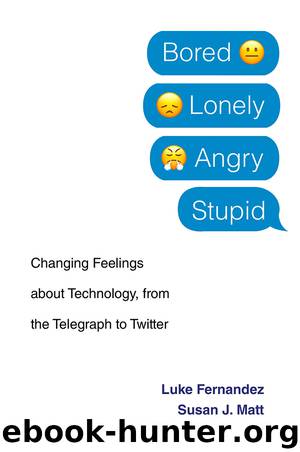
Author:Luke Fernandez & Susan J. Matt
Language: eng
Format: epub
Publisher: Harvard University Press
To Victor and many like him, paying attention was a crucial economic necessity, but it seemed as if there was ever more to know and absorb. Caught up in a high-speed digital economy, these Americans used “attention” and “focus” and “distraction” to describe the demands they were feeling. When a device or social media platform was distracting, it was distracting because it compromised productivity. Conversely, if a technology served to focus attention, they regarded this as a way to enhance productivity. The words our subjects chose, and the meanings they attached to them, reinforced the economic imperatives of the society in which they were socialized or (in the case of many students) into which they aspired to become socialized.
Some found other reasons to lament their declining attention spans. For example, Xavier Stilson, a student, at first offered a pretty conventional account of the relationship between technology and distraction: “There are more distractions and they’re coming up more often.… I know that I need to study … so, yeah, I feel anxious that I need to get that done.… It does take a lot of willpower to turn off the cell phone and put it away and just focus on what you’re supposed to be doing.” After talking with us further, however, he started speaking of digital technology as something that was not only thwarting productivity, but also interfering with people’s ability to tell right from wrong. Asked who and what were threatening the ability to focus, Xavier replied, “Being religious, I … honestly think it could be people who don’t want us to do what is right.… They try to take your focus off of what’s most important.”155
Others worried that their electronic devices were distracting them from human interaction. Stephanie observed, “Do I think that … [technology is] making us stupid? I think it is making us extremely disconnected.” For that reason, she limited the news feeds on her phone, because “I don’t want to be walking around with my face down in my phone.”156 Camree Larkin, an avid user of social media, nevertheless worried that it distracted her from important relationships. “I think I spend way too much time on it. It takes away from calling people to talk to them.”157 While concerns about attention were often expressed as fears about productivity, they could also be expressed as concerns about moral corruption and the degradation of friendship and social life.
This was most evident in Eli Gay’s comments. Eli, the tax preparer in the San Francisco Bay Area, had been taking an extended sabbatical from Facebook and other mainstream social media sites. At first, her reasons for doing so seemed to be related to productivity, when she observed that Facebook was “such a time suck.” But even more, she found that social media distracted her from more spiritually meaningful activities. She talked of the way it created distance at social events, as friends became distracted from conversation and looked down to their phones mid-sentence. Eli, who had a master’s degree
Download
This site does not store any files on its server. We only index and link to content provided by other sites. Please contact the content providers to delete copyright contents if any and email us, we'll remove relevant links or contents immediately.
| Anthropology | Archaeology |
| Philosophy | Politics & Government |
| Social Sciences | Sociology |
| Women's Studies |
The Great Music City by Andrea Baker(33722)
Cecilia; Or, Memoirs of an Heiress — Volume 1 by Fanny Burney(32726)
Cecilia; Or, Memoirs of an Heiress — Volume 2 by Fanny Burney(32090)
Cecilia; Or, Memoirs of an Heiress — Volume 3 by Fanny Burney(32068)
We're Going to Need More Wine by Gabrielle Union(19178)
All the Missing Girls by Megan Miranda(16738)
For the Love of Europe by Rick Steves(14937)
Pimp by Iceberg Slim(14805)
Bombshells: Glamour Girls of a Lifetime by Sullivan Steve(14223)
Norse Mythology by Gaiman Neil(13576)
Talking to Strangers by Malcolm Gladwell(13559)
Fifty Shades Freed by E L James(13353)
Mindhunter: Inside the FBI's Elite Serial Crime Unit by John E. Douglas & Mark Olshaker(9532)
Crazy Rich Asians by Kevin Kwan(9422)
The Lost Art of Listening by Michael P. Nichols(7623)
Enlightenment Now: The Case for Reason, Science, Humanism, and Progress by Steven Pinker(7441)
The Four Agreements by Don Miguel Ruiz(6918)
Bad Blood by John Carreyrou(6739)
Weapons of Math Destruction by Cathy O'Neil(6479)
